In 2017 I asked myself a question I still haven't put down: what does a good life look like, and how would I know if I'm living it? I wrote about where it led in the philosophy behind Good Work. This post is about the step in between: deciding what to track.
Most life planning stops at the vision. You write down what you want, it feels clear for a week, and then ordinary life takes over. Nothing in the plan tells you, three months later, whether you're closer or further away. The plan doesn't fail, it just drifts. What fixed that for me was a short list of numbers that the vision could be checked against.
Life planning starts with a picture of a good life
The exercise that worked for me wasn't a goal-setting framework. It was a single question: what would a perfect day look like? Not a perfect year, and not a bucket list. A day. What would I be doing, who would I be with, and how would I feel at the end of it?
It sounds easy, and it isn't. Ask it at your desk on a Tuesday and you'll describe the Tuesday you already have. Today's constraints answer before you do: "I could never exercise every day, I just don't have the time." Maybe that's true right now. But the question isn't what fits in this week. It's what a good day would be, and working out what has to change comes later.
So set the scene before you ask. Go somewhere that takes you out of your routine: a couple of days in a cabin in the woods, a long hike, a calm place you love. And clear your daily expectations for a while, so the inbox, the to-do list and this week's obligations can't answer for you. This is the step most people skip, and it decides whether you write down the life you want or a slightly tidier version of the one you have.
A day is useful because it's small enough to be honest. "Be successful" doesn't survive the question. "Read before bed instead of scrolling" does. Here is what I wrote down in 2017, more or less word for word:
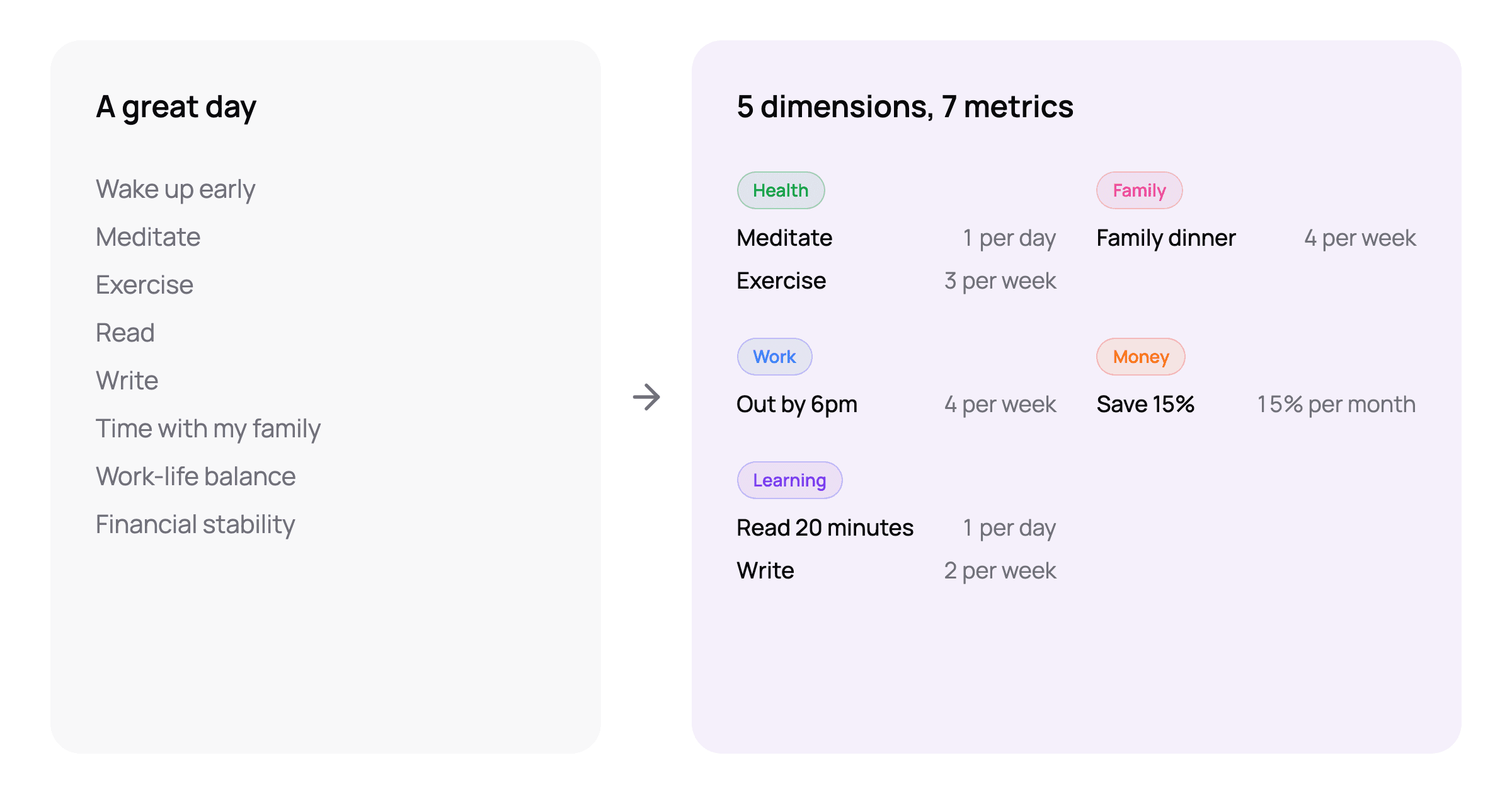
Wake up early, meditate, exercise, read, write, and spend time with my family. Work-life balance, financial stability, and a sense of purpose.
That's the whole vision. It isn't ambitious and it isn't clever, which is the point. Every item in it is something that happens, or doesn't, in an ordinary week.
When you do sit down to write, use plain sentences. You're not committing to anything yet. You're writing down what you'd recognise as a good day if you had one.
From a vision to your dimensions
The next step is to sort the vision into a few areas of life. I call them dimensions: the parts of your life you want to see side by side, so that one of them can't quietly take over the others.
Mine fell into five almost on their own:
- Health: meditate, exercise.
- Family: spend time with my family.
- Work: work-life balance.
- Money: financial stability.
- Learning: read, write.
Notice that the dimensions came from the vision, not from a template. If your picture of a good day has friends, faith, music or a garden in it, those are your dimensions.
"A sense of purpose" didn't get a dimension. I don't think it can be counted, and I'd rather leave it as the question the whole list answers than pretend a number captures it.
What to track in your life: one or two metrics per area
Now the part that matters most: turning each dimension into one or two metrics. A good metric:
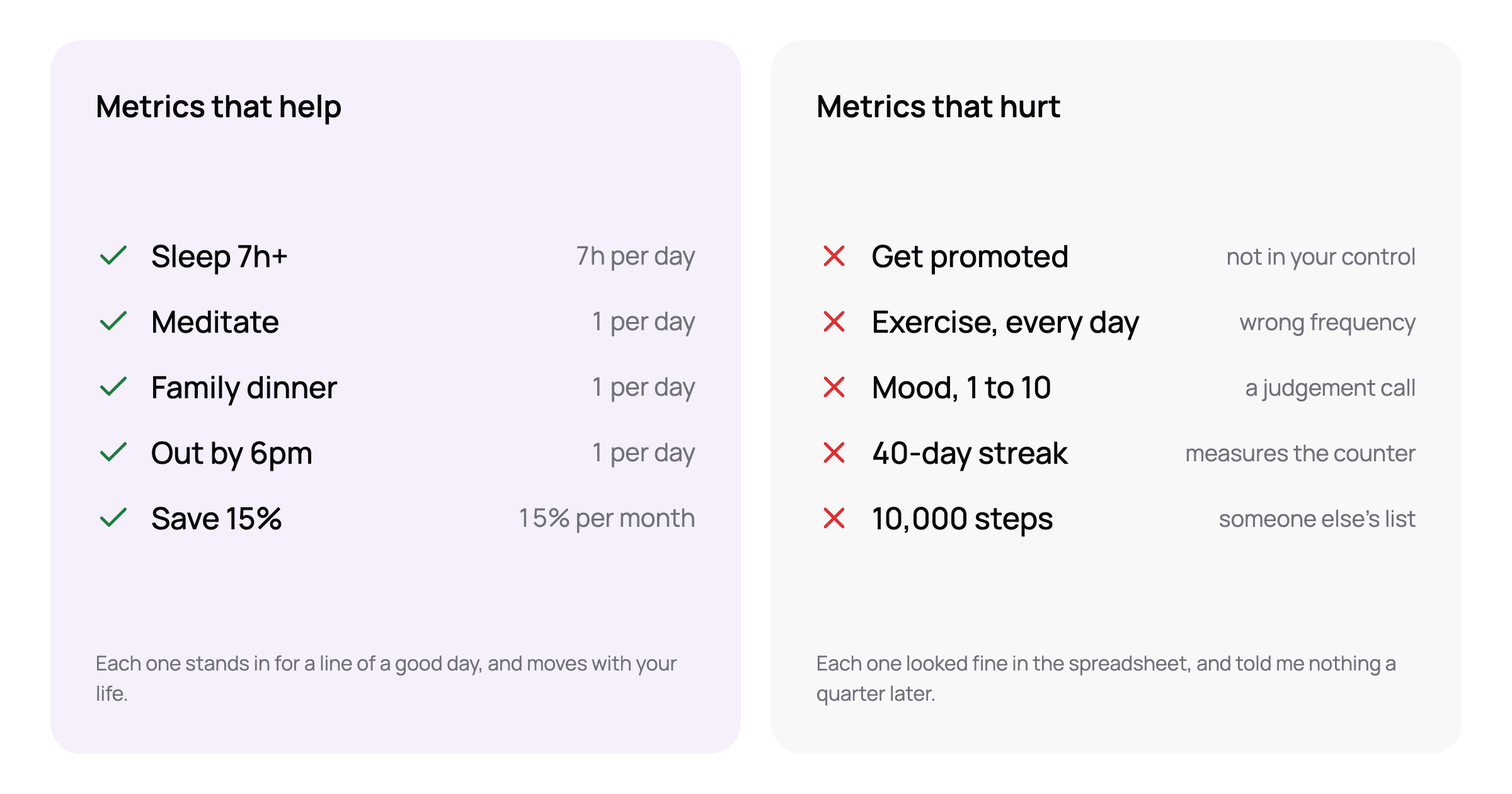
- Is in your control. "Read 20 minutes" is. "Get promoted" isn't, even if it's a fine thing to want.
- Is observable. At the end of the day you know whether it happened without having to think about it.
- Takes seconds to log. If logging it is a chore, you'll stop logging it, and then it isn't a metric.
- Has a target an ordinary week can hit. Not your best week. A normal one, with a cold, a late meeting and a child who won't sleep.
Each metric also needs a frequency, and choosing it is half the decision. Some things belong to the day (did I meditate?). Some belong to the week, like exercise, where a daily target would turn every rest day into a miss. Some belong to the month: savings only make sense once the month's bills are in. Picking the right frequency is what keeps a target honest.
My example: personal metrics from a 2017 vision
Here is how my vision becomes a list. The targets are what I'd set for an ordinary week; they say nothing about how I actually did.
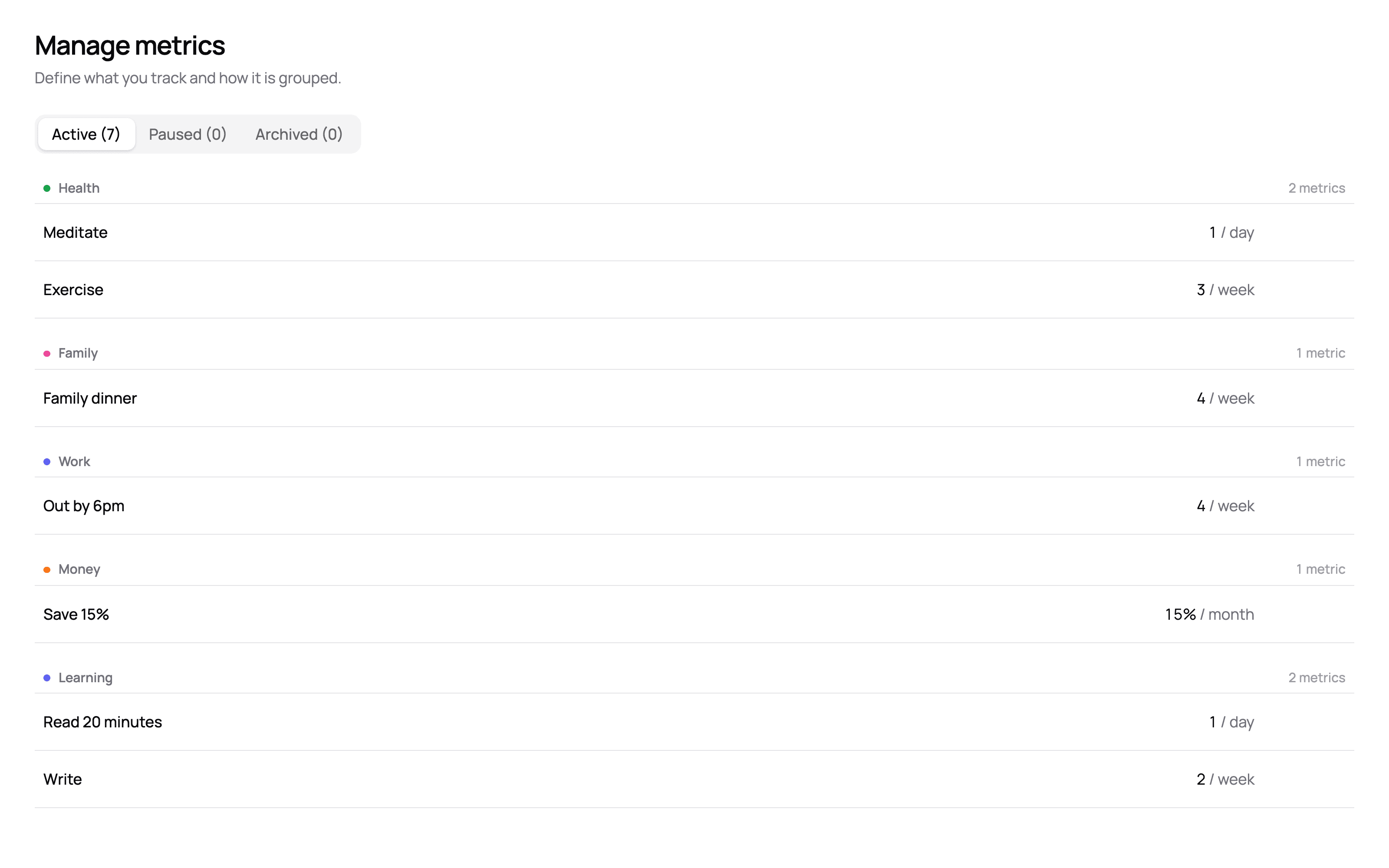
- Health: Meditate, daily. Exercise, 3 times a week.
- Family: Family dinner, 4 times a week.
- Work: Out by 6pm, 4 days a week.
- Money: Save 15%, once a month.
- Learning: Read 20 minutes, daily. Write, twice a week.
A few of these needed a decision:
- "Spend time with my family" became Family dinner, four a week. Time with family is hard to log honestly. A dinner together is easy, and it was the part of the day I most wanted to protect.
- "Work-life balance" became Out by 6pm, four days a week. Balance isn't something I can tick. Leaving on time is, and it was the thing that went first when work got busy.
- "Financial stability" became Save 15%, once a month. One number at the end of the month, not a budget with forty categories.
- "Wake up early" isn't on the list. It's what makes the morning possible, not what I wanted from it. If I meditated and exercised, I woke up early enough.
That's seven metrics across five dimensions. Here it is as I'd set it up in Good Work, each metric under its dimension, with its target and frequency:
Start with fewer metrics than you think
The list above is short on purpose. For about a year I tracked 30 metrics, and I wrote about what that did to me in why habit streaks backfire. Logging took longer than living some days, and every evening there was something I hadn't done. Seven is plenty. Two or three is a perfectly good place to start, and no more than two per dimension is a good rule even once you've settled in.
The right number also changes with your life. When our baby was born, exercise wasn't going to happen for a while, and that was the right call. The useful move wasn't to keep a metric I was going to miss every week, or to delete it and lose its history. It was to pause it, and pick it up again when life had room for it. The same goes for targets: Out by 6pm four days a week might be three in a busy quarter, and that's an adjustment, not a failure. Your metrics are there to describe the life you're living, not to grade it.
Check your metrics every quarter
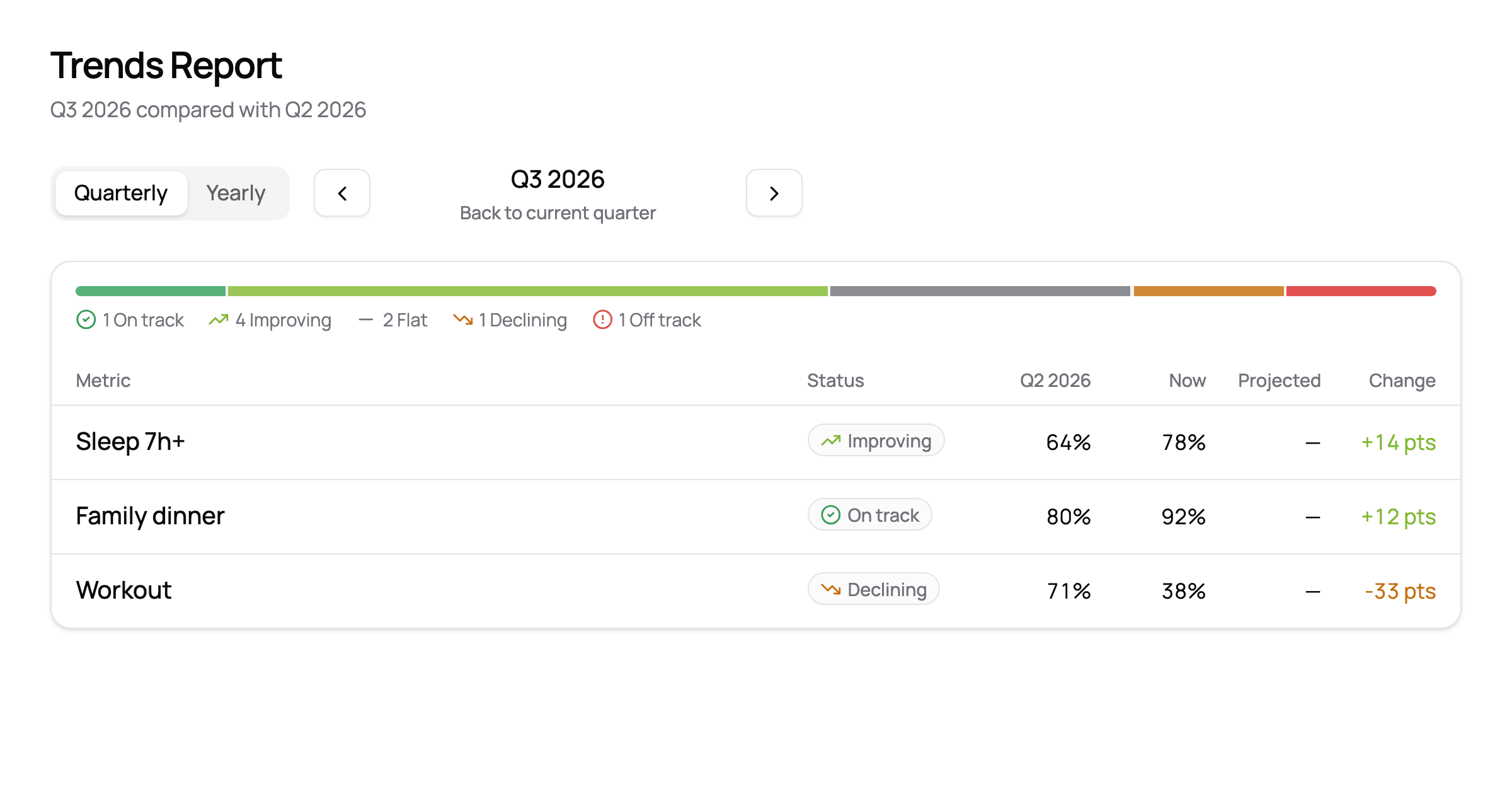
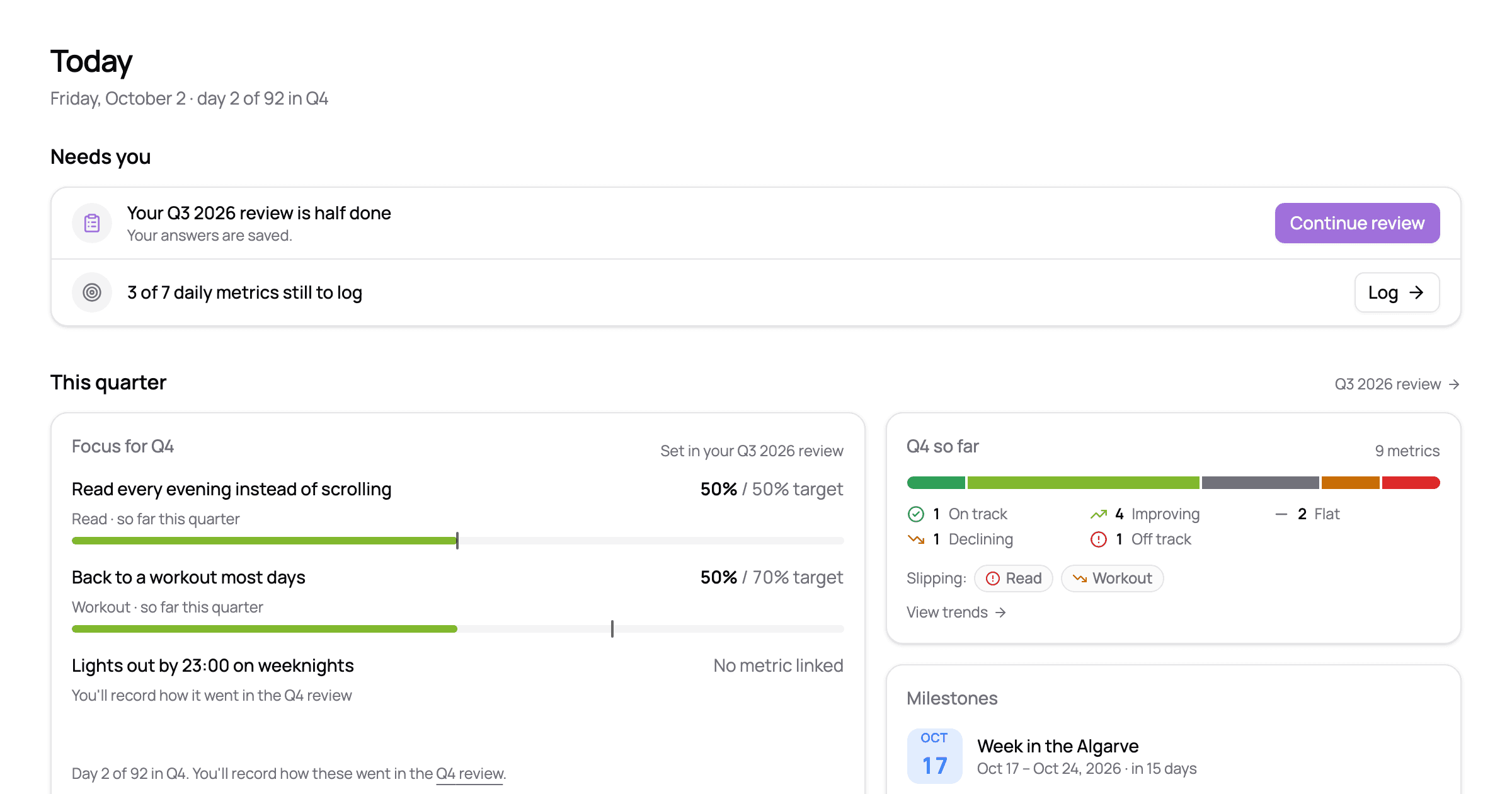
A list of metrics is a hypothesis: if these numbers are where I want them, my life is closer to the vision. Like any hypothesis, it needs checking. I do that once a quarter, in about an hour: what improved, what slipped, and whether each metric still says something I care about. The step-by-step version is in how to do a quarterly life review in 60 minutes.
Most quarters, the answer is to change nothing. Sometimes a metric turns out to measure the wrong thing, or a dimension has gone quiet because life moved on. That's the moment to drop one or add one.
Which metrics help and which ones quietly hurt is a bigger question than it looks, and I've written about it in which life metrics actually help, and which ones hurt. For now, a handful chosen from your own picture of a good day is enough to start.
If you'd rather not build the spreadsheet
I kept this list in a Google Sheet for years, with the dimensions and the metrics. It works, and if you like spreadsheets it's a fine place to start.
Good Work is that sheet turned into an app. You create your own dimensions and your own metrics, give each a target and a frequency, and log them in a few seconds a day. When a season changes you can pause a metric or adjust its target, and your history stays as it was. All of that is on the free plan. The quarterly and yearly Trends reports, which put each metric next to the period before, are part of Premium, which includes a 30-day trial. There's more on how it fits together on the life tracking app page.
Start with your picture of a good day, sort it into your dimensions, and give each one or two metrics with a target an ordinary week can hit. Log what you can.
→ Build your dashboard, free — free plan, no credit card.
Thanks for reading, Henrique