A habit streak is at its most powerful on the day it breaks. The counter said 40-something yesterday. Today it says zero, and nothing about it tells you that you did the thing on almost every day for six weeks. You are, according to the app, back where you started.
I've tracked my life since 2017, first in bullet journals, then in a big Google Sheet, and now in the tool I built for myself. Somewhere along the way I stopped expecting perfect days and began valuing trends, and that shift did more for me than any new metric. In practice it means I don't count consecutive days. I count how often. This post is the long version of why, and of what I look at instead.
Where "don't break the chain" comes from
The habit streak has an origin story, and you've probably heard it. A young comic asks Jerry Seinfeld for advice. Seinfeld tells him to write every day, to hang a wall calendar with the whole year on one page, and to draw a big red X over each day he writes. After a few days there's a chain of Xs, and from then on the only job is: don't break the chain.
The story was told by Brad Isaac, a software developer, to Lifehacker in 2007, and it has been repeated in productivity writing ever since. Most habit apps are that calendar with a counter on top.
The part that gets repeated less often: Seinfeld has said the idea wasn't his, and that he never claimed to use it. James Clear, who wrote one of the best-known articles about the method, added a footnote saying so a year after publishing it, with a link to Seinfeld's own reply in a Reddit AMA:
"It's the dumbest non-idea that was not mine, but somehow I'm getting credit for it."
I don't think that makes the method worthless. A chain of Xs is a good way to get through the first weeks of one new habit, and I'll come back to that. But it's worth knowing that the rule so many apps are built around is a second-hand anecdote, not a finding.
Why habit streaks backfire
A streak counter is a measurement, and like any measurement it's worth asking what exactly it measures. Here is where I think it goes wrong.
It measures consecutive days, not how often you do the thing
These are different numbers, and the second one is the one your life runs on. Someone who meditates every day for two weeks and then stops has a better streak than someone who meditates four days a week all year. Only one of them has a meditation habit.
One miss erases everything
The loss isn't proportional. Miss one day in fifty and a rate goes from 100% to 98%. A streak goes from 49 to 0. Day one after a miss looks exactly like day one of never having started, which is simply untrue, and it's the root of what people call streak anxiety: the longer the chain, the more there is to lose, and the more the habit becomes about the chain.
The research I could find points the other way. In the study behind the often-quoted "66 days to form a habit", Lally and colleagues followed 96 volunteers who each repeated a new eating, drinking or activity behaviour daily for 12 weeks. Their conclusion on missed days is one sentence long: "Missing one opportunity to perform the behaviour did not materially affect the habit formation process." The habit survives a missed day. The streak counter is the only thing that doesn't.
It rewards the smallest version of the habit
When the goal is to keep the chain alive, the cheapest thing that counts as "done" becomes very attractive. One minute of meditation at 23:55. One page. One push-up. There's nothing wrong with a small day, but a streak can't tell a small day from a full one, so over time it quietly teaches you to protect the counter instead of doing the thing.
It can't tell a choice from a drift
This is the one that matters most to me. When our baby was born, my exercise numbers fell off a cliff for two months. That wasn't a lapse. It was the right call, and I'd make it again. A streak app has exactly one way to describe those two months: a failure.
The same goes for a smaller example. This summer my sleep dropped well under seven hours for a few weeks, because the World Cup was on and the matches where I live finished late. I didn't need to think hard about why. A counter that resets to zero has no room for "explained".
What to track instead
None of this is an argument against tracking. It's an argument for a different number. Four things replaced the streak for me.
A rate over a week or a quarter
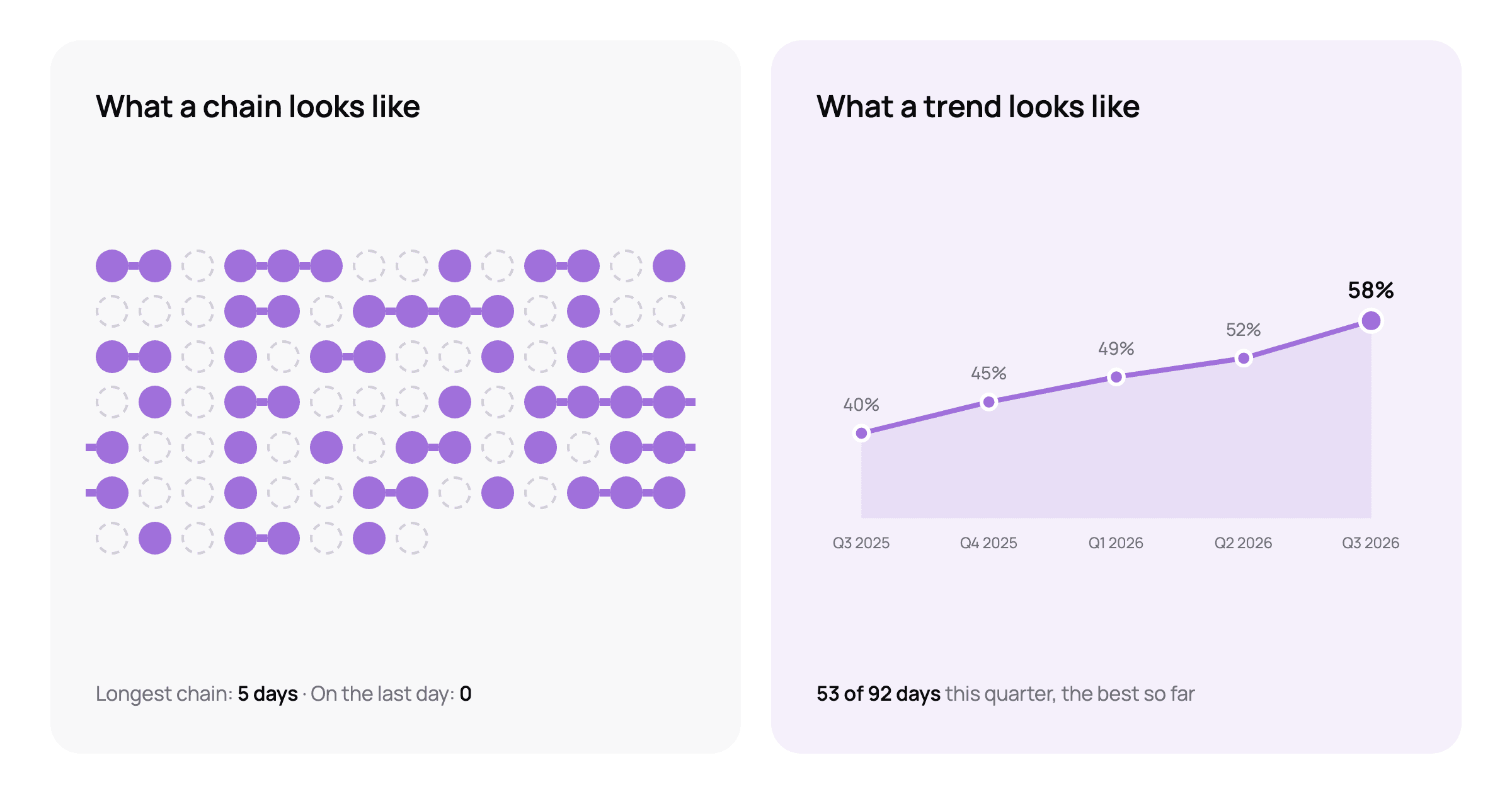
Instead of "how many days in a row", ask "how many days out of how many". For a week, that's 4 of 7 days; for a quarter, it can be 58%.
One of my focus points last quarter was to meditate on at least half the days. I ended the quarter at 58%. Read as a chain, those same days are unimpressive: gaps everywhere, no long run, and a counter that would have spent most of the quarter in single digits. Read as a rate, it's an improvement.
A rate has two properties a streak doesn't. It moves in proportion: one missed day costs one day. And it has a memory: a bad week in July is still visible in September, as a dip, not as a reset.
A target you're allowed to change
A streak has one implicit target, every single day, and it's the same in a calm month and in a chaotic one. A rate needs an explicit target, which means you can set it honestly and move it when life moves.
"At least half the days" is that kind of target. It can be met in an ordinary quarter, and meeting it says more than missing "every day" would. If next quarter is quieter, the target can go up. If it isn't, it can go down. Either way the days I already logged stay exactly as they were. Changing a target isn't cheating. It's the same thing you do with a budget when your rent changes.
Pausing a metric when life changes
Some seasons don't need a lower target, they need the metric gone for a while. The months after our baby was born were like that for exercise. The quarter after, I wrote a plan to get every metric back up, and it lasted a week. What those months needed was a line saying "Exercise: down, expected, revisit in Q1", and nothing asking me about it every evening.
That's what pausing is: the metric leaves your daily view, its history stays, and it comes back when you decide it should. A chain can only be broken. A metric can be put down and picked up again.
This quarter against the last one
The question a streak answers is "did I do it today?". The question I actually care about is "is it improving or declining?". For that you need two periods side by side.
Meditation at 58% means little on its own. Next to the number from the quarter before, it becomes a direction. And a dip that lines up with something that happened, a birth, a tournament, a week of flu, is explained, which is different from broken. I wrote about how I run that comparison, step by step, in how to do a quarterly life review in 60 minutes.
Habit trackers vs metric trackers
Underneath the streak question there's a difference between two kinds of tool.
A habit tracker asks one question: did you do it today? The answer is yes or no, the unit is the day, and the natural summary is the chain.
A metric tracker asks three: how much, how often, and which way is it moving? The answer can be a tick, but it can also be hours slept, pages read or money saved. The unit is whatever period makes sense, and the natural summary is a rate and a trend.
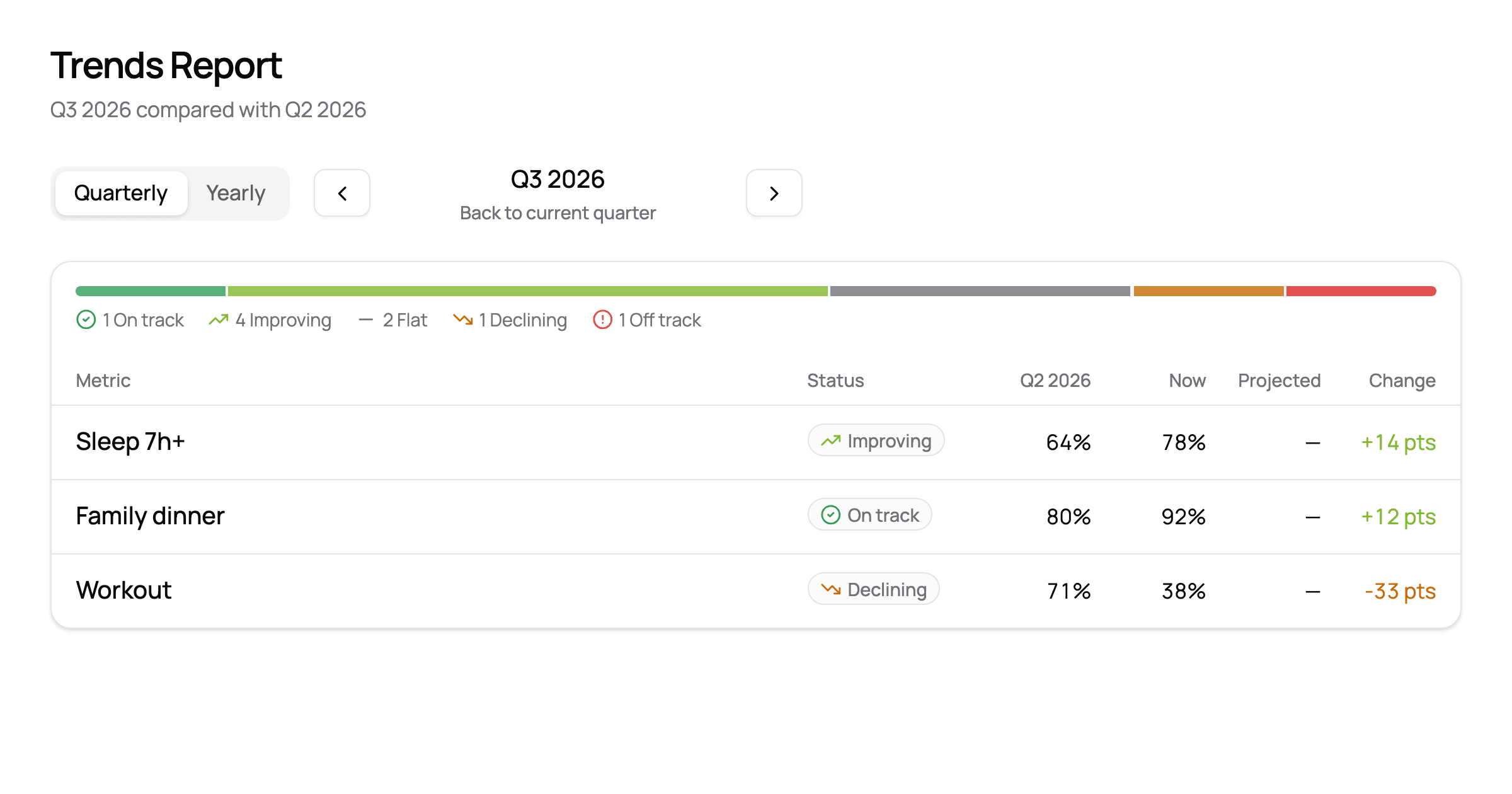
The difference shows up when you track more than one thing. With a habit tracker, ten habits are ten chains, and on any given evening at least one of them is in danger. With a metric tracker, ten metrics are a picture: sleep up, workouts down, family dinners steady. For about a year I tracked 30 metrics, which was too many for any tool, but even at ten I can't imagine keeping ten chains alive. I can easily read ten rates.
To be fair to the streak: there is a moment when a habit tracker is the right tool. If you're starting one new habit and you're in its first few weeks, a chain of Xs is simple, visible and motivating, and the all-or-nothing rule is easy to follow while the chain is short. The trouble starts later, when the chain is long, life is not simple, and the habit is one of many. That's when I'd move it from a chain to a rate.
If the wider idea appeals to you, several areas of life on one screen instead of one habit at a time, I've described it on the life tracking app page.
If you'd rather not count chains
You can do everything above in a spreadsheet, and I did for years, with a column for every metric I cared about.
Good Work is that spreadsheet turned into an app, and it has no streaks. You define your own metrics and give each a target. When a day doesn't happen you skip it, when a season changes you pause the metric or adjust its target, and your history stays as it was. All of that is on the free plan. The quarterly and yearly Trends reports, which put each metric next to the period before and mark what's improving and what's declining, are part of Premium, which includes a 30-day trial.
If you're starting from a streak app, start small: pick the two or three habits you care about most, give each a target you'd hit in an ordinary week, and look at the rate at the end of the month. Log what you can.
→ Build your dashboard, free — free plan, no credit card.
Thanks for reading, Henrique